

Novels to Screenplays

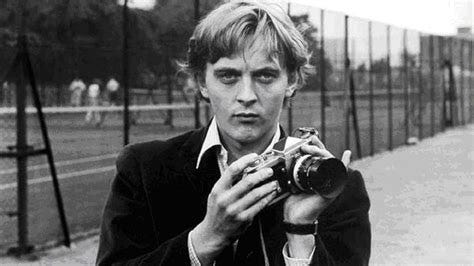
David Hemmings/Blow-Up
[This post is a spinoff of Reading Project [27]: Plays]
1. Five Easy Pieces
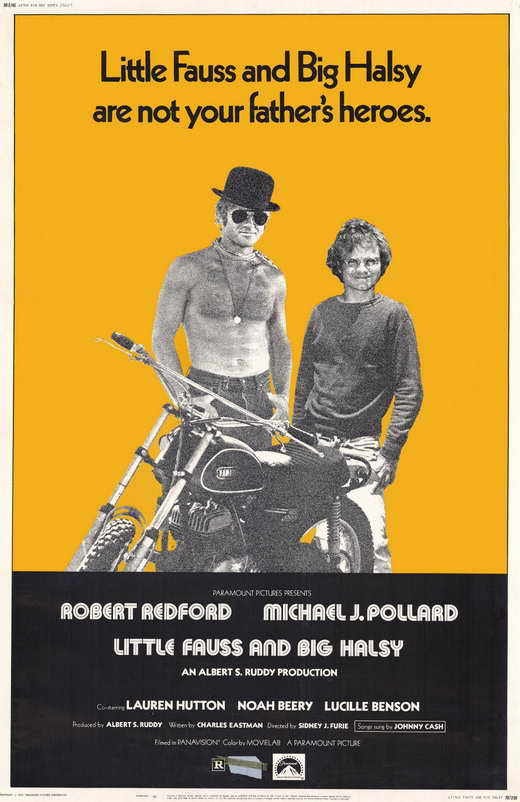
Mid-August, in the 1990s, the Yellow Bay Writers’ Workshop was held on the east shore of Flathead Lake, south of Kalispell, Montana, where I lived. It was there I got to know an aging screenwriter named Charles Eastman, up from L.A. to learn about writing fiction. He was paunchy, had been years on the wagon, was a fount of stories told in the gentle manner of someone carrying old wounds. Everyone loved him. A few of his scripts had become movies—one was Little Fauss and Big Halsy (1970), Robert Redford, Michael J. Pollard, Lauren Hutton. Besides that, he had another claim to fame (in my book, at least): he was the brother of Carole Eastman,1 who’d written what was then, and maybe still is, my favorite film, Five Easy Pieces (1970).
A couple of years ago, I had the wild idea of writing a prose sequel to that film. About twenty pages in I came to see the folly of the project. I sometimes forget that time keeps rolling on—I’m still twenty-something when I think about Five Easy Pieces; in reality, it’s fifty-six years old—some of you may never have heard of it, much less seen it, much less revere it. Not only that, if you watched it now, you wouldn’t see it the way I did back then—you wouldn’t be so enamored of Jack Nicholson’s anti-hero persona, for instance. Anyway, I gathered up materials—stills and YouTube clips and so on—of the ending in particular, because I wanted to keep going from that point.
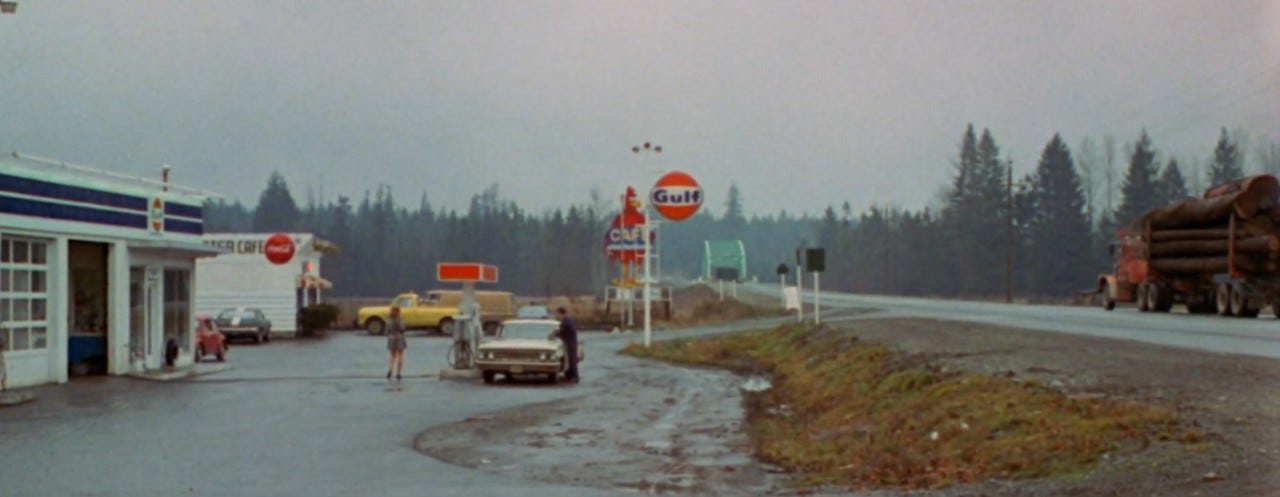
When I went to get the screenplay, I realized that the shooting script wasn’t exactly the one Carole had written (though much was the same). I ended up with copies of both versions. [I should add that, these days, via the internet, you often find “dialog scripts”—just the spoken words of the released film. Unauthorized.]
All this by way of introducing the odd pleasure of reading a screenplay. I’d love to stick in the screenplay pages of that last scene, but there’s no room. Sorry. If you’re interested you can access it here.
2. Novels/Scripts [1]: Some thoughts
If you’re a reader who writes—I used to tell students—you read with one eye on the story, the other on the craft. (An ungainly metaphor, when you picture it, but let’s keep going.) It’s hard to learn from other writers—it’s not hands-on, like woodworking, say. It’s more a case of hanging out with other people’s excellent prose, hearing it, paying attention to it, absorbing it.2 But sometimes you do pop the cover off and look at what the gears and sprockets are up to.
Once in a while, you get the chance to compare how a given chunk of material is handled in different genres. You get to see the prose stripped bare—a few spoken words, a few beats of action. Look at how Harper Lee constructed her courtroom scenes in To Kill a Mockingbird, the novel, then how she and co-writer Horton Foote handled them in the movie script. You see evidence of the questions they asked themselves: What matters most? Where’s the fulcrum of the scene? What needs saying overtly? Which specific molecules of prose, if cut, make the scene’s essence disappear?
Or try it with any accessible adaptation:
The Woman in Cabin 10, Ruth Ware, novel (2016), film (2025)
Room, Emma Donohue, novel (2010), film (2015)
The Life of Pi, Yann Martel, novel (2001), film (2012)
Carrie, Stephen King, novel (1974), film (1976).
3. Scripts/Novels [2]: The English Patient
Once in a while, you get to compare three iterations of a story—novel, screenplay, film. The English Patient makes a great example because: a) both novel and film are sublime works of art, b) the screenplay was written by the film’s director (a writer with his own bagful of credentials—Bafta Award, Emmy, Prix Italia, etc.), and c) the screenplay was published as a handsome paperback with illuminating front matter by Minghella, Ondaatje and Saul Zaentz (the producer).
The English Patient [screenplay], Anthony Minghella (1996).
The English Patient [film], Anthony Minghella (1996).
4. Scripts/Novels [3]: The Lists
a) Four Good Screenplays Adapted from Novels:
Women Talking [novel], Miriam Toews (2018)
Women Talking [screenplay], Sarah Polley (2022)
Gone Girl [novel], Gillian Flynn (2012)
Gone Girl [screenplay], Gillian Flynn (2013)
The Color Purple [novel], Alice Walker (1982)
The Color Purple [screenplay], Menno Meyjes (1985)
The Godfather [novel], Mario Puzo (1969)
The Godfather [screenplay], Mario Puzo and Francis Ford Coppola (1971)
b) Two great Screenplays Adapted from Nonfiction:
Killers of the Flower Moon: The Osage Murders and the Birth of the FBI, David Grann (2017)
Killers of the Flower Moon [screenplay], Martin Scorsese, Eric Roth, David Grann4 (2023)
12 Years a Slave: Memoir of a Free Man Kidnapped into Slavery in 1851, Solomon Northup (1853)
12 Years a Slave [screenplay], John Ridley (2013)
c) One Novel, Multiple Screenplays:
Great books (and great plays) are constantly re-made—to generate new audiences, to re-interpret the text, to use more sophisticated technology, etc. The net is rife with lists:
Comparing adaptations is another way becoming intimate with a text—and your own reading of it. Which Gatsby is better, which Little Women?
More often than we realize, an American film (or TV series) is a re-make of one from abroad. The Kurt Wallander mysteries by Henning Mankell5 have both Swedish and British television adaptations. We get to ponder who inhabits Wallander best—Krister Henriksson or Kenneth Branagh? Ditto for the films of Steig Larsen’s, The Girl with the Dragon Tattoo. Noomi Rapace or Rooney Mara?6
But what I really wanted to call your attention to is The Remembrance of Earth’s Past Trilogy by Chinese computer engineer and novelist, Liu Cixin (2006-2010)7
The Three-Body Problem (2006) [Trans. from Mandarin Chinese by Ken Liu (2014)]
The Dark Forest (2008) [Trans. from Mandarin Chinese Joel Martinsen (2015)]
Death’s End (2010) [Trans. from Mandarin Chinese by Ken Liu (2016)]
d) Adapting Novels: Two Special Cases:
One Flew Over the Cuckoo’s Nest, Ken Kesey (1962)8
One Flew Over the Cuckoo’s Nest [screenplay], Lawrence Hauben and Bo Goldman (1975)
The issue here is point-of-view. The novel is first-person, told by Chief Broom, an Oregon State Mental Hospital patient (inmate?). He’s half-Indian, physically imposing but silent—he pretends to be “deaf and dumb,” which lets him in on everyone’s conversation as he goes about mopping.
In first-person fiction, of course, everything is filtered through the narrator—we see/hear only what he describes for us, and it’s in his voice, having his particular spin. He might be lying/exaggerating/joking/fantasizing (that is, being an “unreliable narrator”). Or he might, on the other hand, be an obsessive truthteller (which is twisty in its own way since the whole shebang is made up). Anyway, movies are always in third-person (sometimes called “third-person objective”). We see everyone from the outside . . . except when voice-overs are used (more on that here9).
So how do you compensate for the loss of the narrator’s spin? A two-part answer: a) what we see isn’t really naked/objective—it’s been spun by the team of director/cinematographer/editor, and b) the story and the acting have to keep us glued to the screen. Cuckoo’s Nest does that. Jack Nicholson’s bravura portrayal of Randle Patrick McMurphy is unlookawayable.10 Chief Broom is still a character (and he has crucial part to play in the film’s ending), but he’s no longer the centerpole of the story.
Fight Club, Chuck Palahniuk (1996)
Fight Club [screenplay], Jim Uhls (1999)11
Speaking of unreliable narrators . . . I can’t talk about this one without giving away its big spoiler. Stop now if you want to avoid spoilage. OK, as readers of the book know, there’s a major act of trickery afoot in the novel—the two principal characters are actually the same person. Easy in prose, a major problem in film because we’re looking right at both characters.12
e) Three Novels Transformed by the Film:
Do Androids Dream of Electric Sheep? [novel], Philip K. Dick (1968)
Blade Runner [screenplay], directed by Ridley Scott (1982)
Dick has had a cult following for years—for the novels and for his influence on subsequent speculative writers. I’ve never read Androids . . . I read his alt-history novel, The Man in the High Castle (1962), always meant to try another but never did. I’m tempted to say he was more gifted at thinking stuff up than putting it on paper (he’s a pedestrian sentence writer). This is no doubt a minority opinion. Anyway, he’s one of the most written-about sci-fi writers. Below, I’ll post a couple sites that explain the differences between Dick’s novel and Ridley Scott’s film. This is an example of an adaptation that starts with the basic story and by changing a series of details makes something new—it’s not simply tweaking the novel for dramatic purposes, it’s a re-imagining of the story, constructing a moody, visually stunning artifact in which everything coheres. You’ve heard me say this before, but here it is again: A work of art is saturated with what it’s about—cut it open anywhere and you find that particular story matter.13
Book vs Film: ‘Do Androids Dream of Electric Sheep?’ vs ‘Blade Runner’
10 Huge Differences Between The Original Blade Runner & The Novel That Inspired It
[Oh, and ever wonder about the title, Blade Runner?14]
Blow-Up [film], Michelangelo Antonioni (1966):
A genre-redefining film—it came out the year my freshman year of college; I loved it (I can still almost play it straight through in my head). That same year, I read Carlos Fuentes, getting my first taste of the Latin American Boom [aka El Boom] and read Julio Cortazar. Blow-up is based on a Cortazar short story, “Las babas del diablo” (later retitled after the success of the film). If Blade Runner was a refinement or re-interpretation, Blow-Up is the creation of a new story using the central thematic elements from an earlier one—that ambiguity can lie at the heart of photographic images, that a character must sometimes live in a state of not-knowing the true nature of what he has witnessed.
About Schmidt [novel], Louis Begley (1996)
About Schmidt [film], screenplay by Alexander Payne (2002)
By chance, I read this novel at roughly the same time the film came out. The film . . . well, it has the same title as the novel; they both have an old guy (Jack Nicholson in the film), and maybe there were some other overlaps, I forget. Talk about taking liberties, I thought. But I discovered that, in fact, the screenplay was a entirely different project, written before the book. The screenwriter, Alexander Payne, says his original script was about "an old guy who retires, and realizes how much he’s wasted his life, and wants somehow to start anew, The Graduate at age sixty-five." The screenplay was rejected, but after Begley’s novel appeared, Payne secured the rights and melded the two works together. Despite his particulars being replaced by Payne’s particulars, Begley wrote in the New York Times that “my most important themes were treated with great intelligence and sensitivity.”
Aside: This section was supposed to be Four Novels Transformed by Film . . . I was going to tell you about Scott Spencer’s 1995 novel, Men in Black15 in which a writer (a serious writer mind you), tires of making no money, decides to slum it and write a sci-fi novel, and (irony of ironies!) finds success.

Carole Eastman: Here’s a quick appreciation from The Cinema Cafe (complete with a clip of the infamous ordering toast scene). And Carole’s Wiki.
Hanging out with other people’s writing: People who’ve hung around with me are undoubtedly sick of this one, but it’s a core belief, Saul Bellow’s dictum: A writer is a reader moved to emulation.
The English Patient [novel]: I came to this novel cold, no frame of reference. I found myself a bit lost . . . how did the parts hook up, where and when were we? Then, the second time through, I couldn’t believe I’d been confused. Some novels don’t hold you by the hand—they ask you to work some things out on your own. Anyway, I love this novel.
Killers of the Flower Moon:
Henning Mankell: I just visited his Wiki page and was freshly blown away by his accomplishments—besides the 13 Wallanders, he wrote a slew of other novels and children’s books, and several dozen plays, besides which he was a heavy-duty political activist, etc. You should have a look.
Rooney Mara: I know who gets my vote.
Remembrance of Earth’s Past Trilogy: I loved reading these—deeply engaging, gave the impression of serious science. I was hot to see how they’d come out on the screen. As it turns out, there were two versions, one American, one Chinese (actually, three—there was an earlier Chinese adaptation that didn’t get aired).
The first season of the American version [8 episodes] appeared on Netflix in 2024. Some aspects of the story were transposed to England. I watched eagerly. It has an embedded strangeness that gets inside you. Parsing the critical response in both countries as well as the cultural commentary is way too complicated to get into here. You can read Wiki’s summary.
And read about the 30-episode Chinese adaptation here.
And read about the three-body problem in physics here.
Cuckoo’s Nest: The link at the title will take you to Bookshop.org. Once at the opening page, you’ll see that the novel generated a slew of books analyzing it—lit crit, studies of the psychiatric treatments, and various other aspects. Not to mention merch:

Voice-overs: Sometimes, after test screenings, the money people will insist that voice-overs be inserted because the film is deemed hard to follow. A famous example is Ridley Scott’s masterpiece, Blade Runner (1982). There have been multiple “cuts” of this film, some with, some without. Generally, directors hate adding voice-overs—film being a visual medium, the images should do the job; they see the addition of voice-overs as dumbing the work down. [I need to say, also, that the various editions of Blade Runner are confusingly named—the “director’s cut,” for instance, wasn’t done by the director, Scott. If you’re up for a rundown of these iterations, go here.]
That said, some voice-overs are an intrinsic element of the film—they can act like a Greek chorus, or add wry commentary/counter voice to what we’ve just seen. You probably won’t recognize this name, but Jean Shepherd’s films and TV series are a great example—hang with me a moment, OK? A Christmas Story (1983) you do know—Red Ryder B.B. gun, lamp in the shape of a lady’s leg, kid’s tongue frozen to the flagpole? That film was a remake of a Jean Shepherd piece called The Phantom of the Open Hearth (hilarious!), which was based on his book, Wanda Hickey’s Night of Golden Memories (1971). I’m sorry more people don’t remember him. Read about him here.
Another good example of voice-over as a commentary on the action is Arthur Penn’s Little Big Man (1970), an early Dustin Hoffman vehicle, based on Thomas Berger’s novel of the same name (1964). Another of my favorites. I wrote about LBM in Birth Year Project 1964 (footnote 3).
Nicholson: The film, cast, crew, etc. won a slew of awards, including Best Picture and Best Actor for Nicholson.
Fight Club screenplay: See this also—a good analysis of the film.
A major problem in film: Since one of the actors involved is Edward Norton (Brad Pitt’s the other), I’ll mention a different Norton film, Primal Fear (1996), which demonstrates one strategy for coping with this problem: multiple personality—both characters look the same on the outside. The film is a “legal thriller” revolving around the defense of a character charged with killing a priest. It manages to pull of a major trick: the guy on trial is a hapless dim-witted young man; his defense is that he has another personality within him—evil, manipulative, contemptuous of his host. We buy it (or at least I did)—the poor kid should get off, it’s not his fault. Then the reveal: it’s all an act—the dim-wit is a creation perpetrated by the real character, the conniving amoral personality.
Saturated with what it’s about: I always use the example of Picasso’s “Guernica”—every square inch of the canvas contains Guernica-ness.
Blade Runner, the title: The term doesn’t appear in Dick’s novel. It was invented by doctor/sci-fi writer, Alan E. Nourse, who titled his 1974 novel Bladerunner—his bladerunner was a doctor who dealt in contraband medical equipment. William S. Burroughs [of Naked Lunch fame] wrote a (much-altered) screen adaptation of Nourse’s novel, which he couldn’t sell, and then turned into a novel (confusingly) titled Blade Runner: A Movie (subsequently filmed by someone else as Talking Tiger Mountain.
Then: Ridley Scott asked co-writer, Hampton Francher, to come up with a name for Rick Deckard’s profession; Francher remembered Burroughs’ novel, liked how “bladerunner” sounded, borrowed it for Deckard, and later it became the film’s title (since Dick’s title was too ungainly and because the story had changed significantly). Got that?
Men in Black: Novel by Scott Spencer (1995), in which a serious writer scores a hit only when he writes a schlocky sci-fi novel about UFOs. I was going to say that filmmakers ditched everything except the sci-fi story within the story when making the first Men in Black film. Then I come to find out the that the film was based on a comic book series, written before Spencer’s novel. I can find nothing that connects the two other than the shared title.
If you want to "learn hands on, like woodworking" about adapting a novel to screen, you need go no further than to study The Godfather Notebook, a big, fat exact replica of Francis Ford Coppola's working notebook, in which he literally tore apart a copy of the novel and wrote in thousands of notes, questions, concerns, and annotations to himself, followed by a detailed scene-by-scene outline, not just of the action and dialogue, but also the mood and colors and sounds, together showing in detail the great depths and struggles he went through to transform the book to film. It should be a required textbook for anyone who wants to understand the art and craft of storytelling, both for fiction writing and screenwriting.
https://www.amazon.com/Godfather-Notebook-Francis-Ford-Coppola/dp/1682450740
Also thinking of movies that vastly improve on the source material. I am thinking especially of The Bridges of Madison County which was a cringy misogynistic “romance” about (essentially) a serial womanizer, but Clint Eastwood (of all people!) flipped that story upside down and made a movie that gives the power and the point of view to the woman.