

Remembering: Novels about Memory [1]
Part One of a Two-Parter

New subscribers & followers, Welcome! I promise not to waste your time.

—from Remembering Plains series, Alyson Kinkade
[https://www.alysonkinkade.com]
Note [a]: Please click through to the Substack site (i.e. don’t read from email notification). Why? It will make me happy to know you’re seeing posts the way I put them up. And they’re best read on tablet or laptop.
Note [b]: OK, this is difficult to write: It’s come to my attention that several of you are skipping the footnotes. I know, I know, hard to believe . . . because that’s where the juicy stuff is, you know? The nuggets of back story and whatnot, the1
Remembering:
1. . . . she purrs like a kitten ′til the lake pipes roar
At some point in my extensive married life, I realized that “memory” was actually a constellation of phenomena. My esteemed spouse remembers what she wore in the fourth grade. She remembers which summers we went where and with whom. I remember being dog tired and passing No Vacancy sign after No Vacancy sign somewhere in the guts of northern Minnesota, a cranky preschooler in the back—I could work out a time range from that last item (if in fact it was one cranky preschooler and not one cranky preschooler plus one red-headed third-grader)2 . . . you see where I’m going with this. For me, events float untethered in time. Yet I can conjure up every inch of the house I lived in from 1952 to 1966; ditto the school buildings I spent my days in. I can name Dickens’ novels and most of Zola’s 20-book Les Rougon-Macquart. I can tell you the birth names of Muddy Waters and Howlin’ Wolf, the lyrics of “Little Deuce Coupe,” and most of the theme song of Dick Summer’s Night Life radio show on WBZ [One hen, two ducks, three squawking geese, four Limerick oysters, five corpulent porpoises, etc.]3
Anyway, today were looking at how novelists use the element of “memory.”
The whole business of reading and writing is saturated by remembering. The writer remembers an incident or dream or scrap from media; into the writing it goes4 —straight/complete, or a snippet, or a funhouse-mirror version. Sometimes the story is about remembering, sometimes the writer is using fiction to ferret out the truth of personal experience, because doing it via memoir is too painful/too self-exposing/too hurtful to others. Sometimes the disguise isn’t meant to fool anyone, but to avoid lawsuits, etc. Once in a while, a writer tries it both ways.5
Many years ago, reading one of Milan Kundera’s essays on writing, I was gobsmacked by this statement:
Remembering is not the negative of forgetting. Remembering is a form of forgetting.6
This explains why media depictions of, say, the 1960s, always get it wrong. They show the costumes, the iconic photos, the lingo, the peace signs. But you had to be there to get it—the vibe, the hierarchy of values, what a given object meant, besides which “the 1960s” was a wildly heterogeneous jumble of subcultures—who, exactly, are you talking about? But back to Kundera, and what I think he means: That the moment you commit a particle of life to memory you trigger the process of forgetting almost all the rest—the off-to-the-side details, the build-up, the nuance, and so on.
The moment you commit a particle of life to memory you trigger the process of forgetting
A few posts ago, I cited two memory-based novels (one I love, one I admire) that use a common strategy—William Maxwell’s, So Long, See You Tomorrow (1980) and Ottessa Moshfegh’s, Eileen (2015). Let’s start our taxonomy there. Both novels are told in first-person. Maxwell’s begins with an old man’s memory of a murder that happened when he was a boy, a farmer shot by his neighbor, and the reason he’s never forgotten it. Moshfegh’s begins with an older woman’s cold-eyed depiction of herself as a drab young woman. [More on how this design operates here.7]
So this is the first sort of “memory novel”—a character (or outside narrator) presents a set of events from an earlier plane of their (or the character’s) life; they’re remembered because they’re significant. You might argue that all past-tense novels do this, but in the ones here remembering is a catalyst. Maxwell’s narrator has been haunted by a small act of omission he committed a lifetime ago—finally, he must tell us about it, and about his not forgetting it.
Moshfegh could’ve written her novel in straight third-person—indeed, the distance between her two selves almost seems like the distance between strangers. The younger Eileen is unhappy, trapped-feeling, ripe for manipulation. We’re told almost nothing about the older Eileen’s circumstances, but in her voice we hear the disdain for her younger self, as well as her staunch unwillingness to look back through rose-colored glasses.8

2. Loss of Memory:
Last week I read about 80-year-old Samuel A. Simon—a former lawyer who worked for Ralph Nader—who performs a one-man show about losing his marbles: Dementia Man: An Existential Journey. God, what courage, I thought. Here’s a link to the Washington Post story I read. [Have a look.]
For those in my cohort, the loss of marbles is the monster under the bed. Film and literature show us what it looks like from the outside, how vexing it is to manage our Alzheimer’s-afflicted elders or partners—for instance, The Father (2020), with Anthony Hopkins, and Iris (1998), John Bayley’s horrifying account of his wife (the acclaimed novelist Dame Iris Murdock) descending into dementia.9
Many of us have seen people we love suffer this fate and find ourselves trying to imagine it from the inside; this entity you’ve known for so long, the self— your pal, your tormenter, your archivist—turning its back on you and leaving, step by quiet step.
Read about consciousness and you’ll come across the line: Mind is what brain does. If, like me, you view consciousness as an emergent state (like a hologram), that pithy statement feels correct. But it asks you to view memory as an assemblage of biochemical transactions . . . not so different from the Jumbotron’s replay of your favorite outfielder’s homerun-denying leap above the centerfield wall: if x-number of its pixels go dark, it’s only a senseless smattering of lighted dots.
Novelists have tackled memory loss from a slew of angles. Many are straight literary realism (like Maxwell’s and Moshfegh’s novels). They’re about memory eroded by age/illness. The good ones work because their detail is keen and unexpected, their sentences are smart and have a voice; despite Alzheimer’s being increasingly familiar as a subject, we’re still moved by them.
Here are four:
Goodbye, Vitamin, Rachel Khong (2017)
Elizabeth Is Missing, Emma Healey (2014)
The Wilderness, Samantha Harvey (2009)10
Still Alice, Lisa Genova (2007)
Writers at the thriller-y end of the spectrum favor “amnesia”—sudden memory loss from violent accident or psychic trauma (or whatever). The Who Am I? plot, the Who Is She Really? plot. Amnesia comes with a sackful of subspecies—Can’t remember anything before [point in time], can’t remember anything after [point in time], etc. It’s the gift that keeps on giving. One Goodreads list of books with amnesia has 837 titles.11 And let’s not forget Christopher Nolan’s twisty film Memento (2000).12 A character suffers from severe short-term memory loss (can make no new memories, tries to cope by leaving himself a string of notes and photos, even tattoos). What could possibly go wrong?
Or the Bourne films, adapted from Robert Ludlum’s, The Bourne Trilogy (1980-1990).
In Remembering, Part Two [2 March], we’ll dive into how meta/speculative fiction writers have used memory loss/memory recovery and related ideas in their work. For now, here are two amnesia novels that are a bridge to that post:
Noah’s Compass, Anne Tyler (2011)13
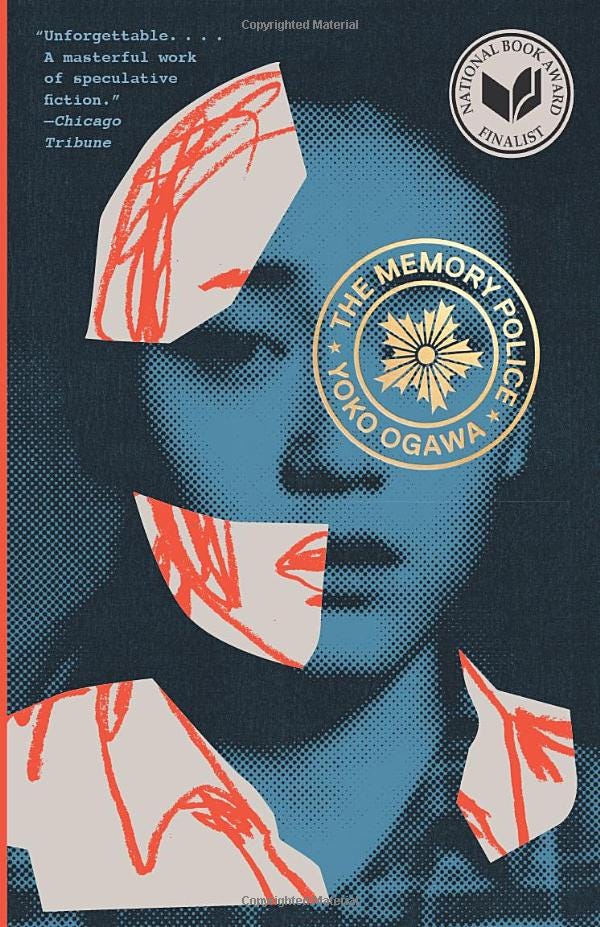
The Memory Police, Yoko Ogawa (1994). Trans. from Japanese by Stephen Snyder (2019). This was one of my 2020 top-five reads. It’s better if you go into it cold—not that there’s a shocking reveal, but the mood is uncanny/normal-but-strange; it settles over you like a mist. The nutshell: People in an island community have their memories/knowledge of things erased by the Memory Police, one at a time—ribbons, scents, birds, harmonicas, novels, body parts, and so on.14 Here’s the Booker page.
3. When Memory Fails:
Sometimes it’s not the capacity to remember that’s lost, but its accuracy, its trustworthiness. Time can degrade memories, memories can warp under pressure, or become entangled in unrelated thoughts. We can be tricked into certainty by our own psyches, our preconceptions/prejudices, our own conscious and unconscious needs. We can even confuse our partner’s memories with our own.15
For centuries, the identification of suspects by eye witnesses was a backbone of criminal justice—it seemed rational, and much of the time it worked. But n recent years, new forensic tools and evidence-based studies have thrown a harsh light on the frequency of wrongful conviction due to misidentification. My own eyes were opened to the scale of this injustice by a powerfully appalling work by lawyer Barry Scheck (and co-authors), Actual Innocence (2000). Scheck was a driving force behind The Innocence Project. I don’t have room to expound on their work here, but you should take a moment to look at their data:
One of the most masterful recent novels about the impact of wrongful incarceration is Tayari Jones’, An American Marriage (2018).16
We love stories of exoneration, especially those like To Kill a Mockingbird, where a Black man is redeemed. We know it’s a fable, we know that for every courtroom with an Atticus Finch, there were a hundred lacking one. We know that racism attaches to a great many misidentifications—whether conscious bigotry or the bias that keeps us from locking in the distinguishing features of races other than our own, or the fact that so many of the accused are represented by harried overloaded public defenders.
Working on this post, I turned up a slew of good booklists relating to wrongful conviction (not all rely on flawed memory). Here’s one from The Innocence Project—all books written by exonerated prisoners:
And another from Jessica Henry, former public prosecutor, now a writer, professor and podcaster:
A catalog of nonfiction works from Celadon Books:
One from the Electric Literature’s site:
https://electricliterature.com/8-books-that-question-the-reliability-of-memory/
And one devoted to thrillers:
4. And finally . . .
Well, I intended to wrap up today’s post with a look at the pseudo-science of “repressed memory therapy”—the practice of coaxing stories of childhood sexual abuse from patients. For a time, starting in 1980s, the psych world was awash in these accounts. Some were true, many weren’t. Eventually, the sketchiness of the methodology became obvious and the hysteria passed; in the meantime lives were ruined.
As it turned out, having been unable to avoid the news lately, my sexual-abuse-of- children compartment was already way over-stuffed. If you’d like to recommend a novel devoted to this subject, feel free to stick it in the comments. For now, I’ll leave you with a short list of nonfiction works:
Memory Warp: How the Myth of Repressed Memory Arose and Refuses to Die, Mark Pendergrast (2021)
The Truth about False Memory Syndrome Paperback, James G. Friesen (2019)
The Myth of Repressed Memory: False Memories and Allegations of Sexual Abuse, Dr. Elizabeth Loftus (1996)
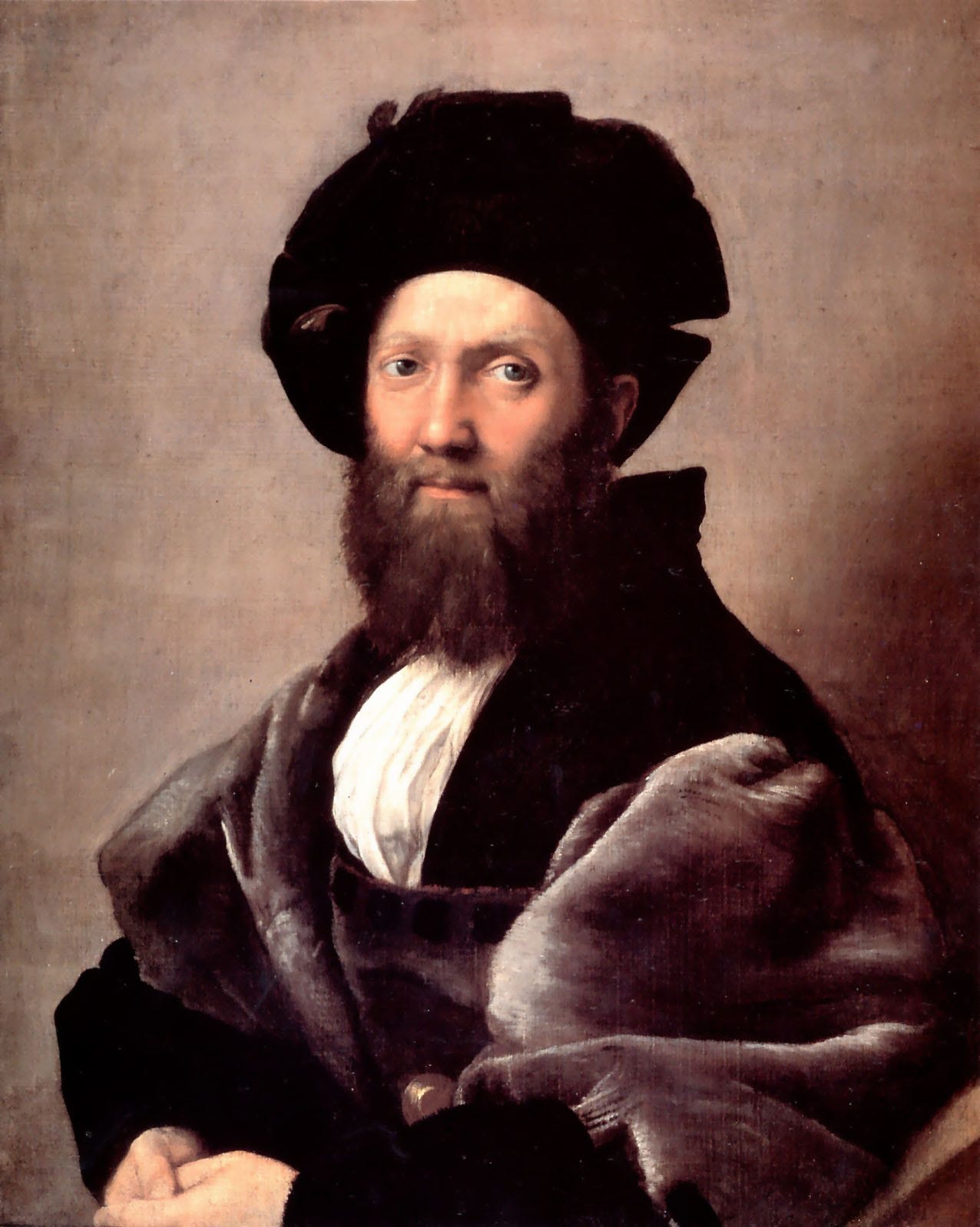
Portrait of writer Baldassare Castiglioni (The Book of the Courtier) by Raphael
Years ago, in a class on the art of the High Italian Renaissance, I ran into a paradigm that’s stuck with me—as follows: By the early 1500s, generations of artists had gradually refined the art of oil painting, leading to the era of Raphael, Michelangelo, Leonardo, Botticelli, and others, a period of sublime portraiture. But the next wave of artists faced a problem: What next? What do you do in the wake of our elders’ perfection? The answer was Mannerism, an art movement that went beyond the bounds of realism—garish colors appeared, exaggerated/elongated limbs, extreme perspectives (the prone body of the dead Jesus seen end on, from the bottom of the feet, the rest of the figure barely visible).
So, the paradigm: art mining rich veins until the run out, then veering off, beginning new veins. Over and over and over. I was thinking of this because (except for The Memory Police) today’s examples operate in the real world. Part Two’s writers veer off. They all seem to be asking: What else can we do?
OK, see you in two weeks.
Reminder that the Birth Year Project is still open for business:
You supply your birth year, I respond with an overview of what was published that year—the popular/well-known titles first, then some books I’d recommend. If your year’s already been done, I’ll do an update. So far, we’ve done 29 years—between 1939 and 1992 (age range: 33 to 86).
The current census: 1992 // 1989, 1986, 1984, 1981, 1980 // 1978, 1973, 1971 // 1969, 1966, 1965, 1964, 1963, 1961, 1960 // 1959, 1958, 1956, 1955, 1954, 1952, 1951, 1950 // 1948, 1946, 1945, 1944 // 1939
Extra credit: You read one of the books (ideally one you’re unfamiliar with), then tell me what you thought. If we get enough of these, I’ll aggregate and post.
the: That wasn’t so hard, was it?
No Vacancy: It was the summer of 1979, I am now informed (esteemed spouse), “the day before the car broke down” (that, I do remember, though not that it happened on the same trip). Plus, I was taking a bit of writer’s license—the kid in back was the red-headed one, three years old, and, really, a good traveler. Tomorrow is his fiftieth birthday. [PS: we finally got a room.]
Dick Summer: Want the rest?
Six pairs of Don Alverzo’s tweezers, Seven thousand Macedonians in full battle array, Eight brass monkeys from the ancient sacred crypts of Egypt, Nine apathetic sympathetic diabetic old men on roller skates with a marked propensity to procrastination and sloth, Ten lyrical spherical diabolical denizens of the deep who haul stall around the corner of the quo of the quay of the queasy at the very same time.
Apparently this was on old radio announcer’s warmup exercise. Anyway, Dick Summer was one of the early hints I got that the world contained some splendid wackiness. Also, his show was my first experience of Eric Clapton-esque soloing, before which guitar solos sounded like what you heard on “Louie Louie.” Not to gainsay “Louie Louie,” but this was seismic, this was like the Dark Ages giving way to the Age of Enlightenment.
Into the writing it goes: John Lennon’s half of “A Day in the Life” began with a report in The Daily Mail of a Guiness heir’s death in a car crash; he mashed it up with a different day’s story about potholes that needed filling in Blackburn, Lancashire.
In a recent post I talked about not writing autobiography—that is, not telling my story. Yet you have to get down the page; bits of your experience find their way in. When I was writing a scene in the short story “Morphine”—a married doctor, half-drunk, drives his Buick around on a frozen oxbow, “cutting donuts” for the benefit of his “younger lady friend”—I remembered the afternoon we’d skated on Church Slough, south of Kalispell. The surface of the ice was usually snow-crusted, but that day it was bare, the ice hard and glassy; as we glided along a muskrat swam beneath us, matching our pace, air bubbles trailing out behind; finally it disappeared into a den in the bank.
Into the story it went.
Both ways: There’s the case of Kathryn Harrison. Her first two novels treated father/daughter incest [the daughter was not a child I need to point out]; they were well-reviewed but didn’t sell like hotcakes. Later, she published The Kiss: A Memoir (1997), which laid out the details of her affair with her father, and it set off fireworks. She was praised in the Times Book Review by Susan Cheever, but savaged elsewhere. The severity of the reaction became its own story; Mary Karr unfolded this flap in the Art of the Memoir (“The Public and Private Burning of Kathryn Harrison”).
https://en.wikipedia.org/wiki/Kathryn_Harrison
[On the off-chance one or two of you don’t already know this, the Frenchies call a novel with thinly veiled depictions of real people, a roman à clef.]
Kundera: “Á la Recherche du Présent Perdu,” in Testaments Betrayed (1993), trans. from French by Linda Asher (1995). Kundera often did that to me.
[Note, esteemed spouse hates it when I use the word gobsmacked. Pretentious, she feels, an affectation. I’ll give her that. Then again, I’ve become an Anglophile in my dotage, and, really, isn’t it a terrific word? My gob has been smacked! But I promise not to use it again in today’s post, OK?]
Story design:
Telling a story from much later, you have to decide which POV to stress, the now of the telling (which emphasizes how the narrator’s grasp of past events has evolved over time) or the immediate aftermath (when there’s more confusion, when the details and their meaning are still being sorted).
You also have to decide how present the narrator-as-much-older-person will be. Such a narrator can keep stepping in, reminding us of the gap between then and now. Or the opposite: establish that it’s a looking-back story, then disappear until, perhaps, the end (which makes it a frame story). Or—a common variation—insert the older voice just often enough to remind us that the story has two planes. I remember using this example in an earlier post, but the film Little Big Man has Jack Crabbe, the 121-year-old last survivor of the Battle of the Little Horn, telling his story to an interviewer, but except for the very beginning and the very end we see LBM as a young man, the occasional crackly voice-over reminding us of the frame.
Interestingly, The Usual Suspects does the reverse: the story’s kick-in-the-pants comes from the fact that although we know everything we’re seeing is actually a story being told by a character, we forget, setting up one of all-time twistiest movie endings—tight shot of a man’s legs as he walks down the sidewalk, limping, pigeon-toed a few steps then all at once breaking into a normal gait. Cryptic, I realize, if you don‘t know the film, but hasn’t everyone seen it at least once??
Eileen: Moshfegh is a master of voice. A later novel, My Year of Rest and Relaxation (2018) pulls off a marvelous stunt: Her character’s quest is to knock herself out for a year, via drugs she gets from her shrink (that relationship is broad satire, a hoot . . . if you let yourself laugh); in between her sleeps, she abuses her one good-hearted schlub of a friend. You wouldn’t like this narrator, but you watch her gleefully. The better angels of many readers will keep them from appreciating this one. My advice: listen to your lesser angel. Then there’s her early novella, McGlue (2014). I dare you.
Iris: Jim Broadbent won the Best Supporting Actor Oscar for portraying Bayley in the 2001 film adaptation. I’ve never read Murdoch. I should.
Samatha Harvey: Are you wondering why the name’s familiar? She won the 2024 Booker for her slender novel, Orbital, which imagines a 24-hour span aboard the ISS.
Goodreads: The principal cause of amnesia in fiction is the dread Needaplot Syndrome.
Memento: Adapted from a short story by his brother, Jonathan Nolan.
Noah’s Compass: I have yet to read this one. Anne Tyler was a catalyst for me when I was a young fiction writer, especially Dinner at the Homesick Restaurant (1982). Click on the link and you’ll see what Bookshop.org says about it. I confess that I sometimes buy other stuff from Amazon, but never books. Bookshop.org is the go-to—they donate $$$ to indie bookstores; I also get books from the Elliott Bay Book Company.
The Memory Police: Is it allegorical? Of course, but below the surface—like some of the best speculative lit, you settle into this world the way you do with any good literary novel. But allegory: I mention this because it touches on a subject I’ve skipped in today’s post, the erasure of a group’s memory: the suppression of language, identity, and cultural expression by the Powers That Be—it deserves far more attention than I can give it today and will have to wait for another time.
And here’s a fantasy novel by Peng Sheperd that also deals with memory loss spreading through a group, The Book of M (2018).
Our partner’s memories: As recently as this week, esteemed spouse said: Uh uh, you weren’t there. I told you about it. Me: Oh.
An American Marriage: Sample the rave reviews at LitHub.
Gobsmacked is my favorite word and I love to come across it! If I were a tattoo kind of gal, that would be mine.
That Kundera quote! Am going to go find his essay...